Quick answer
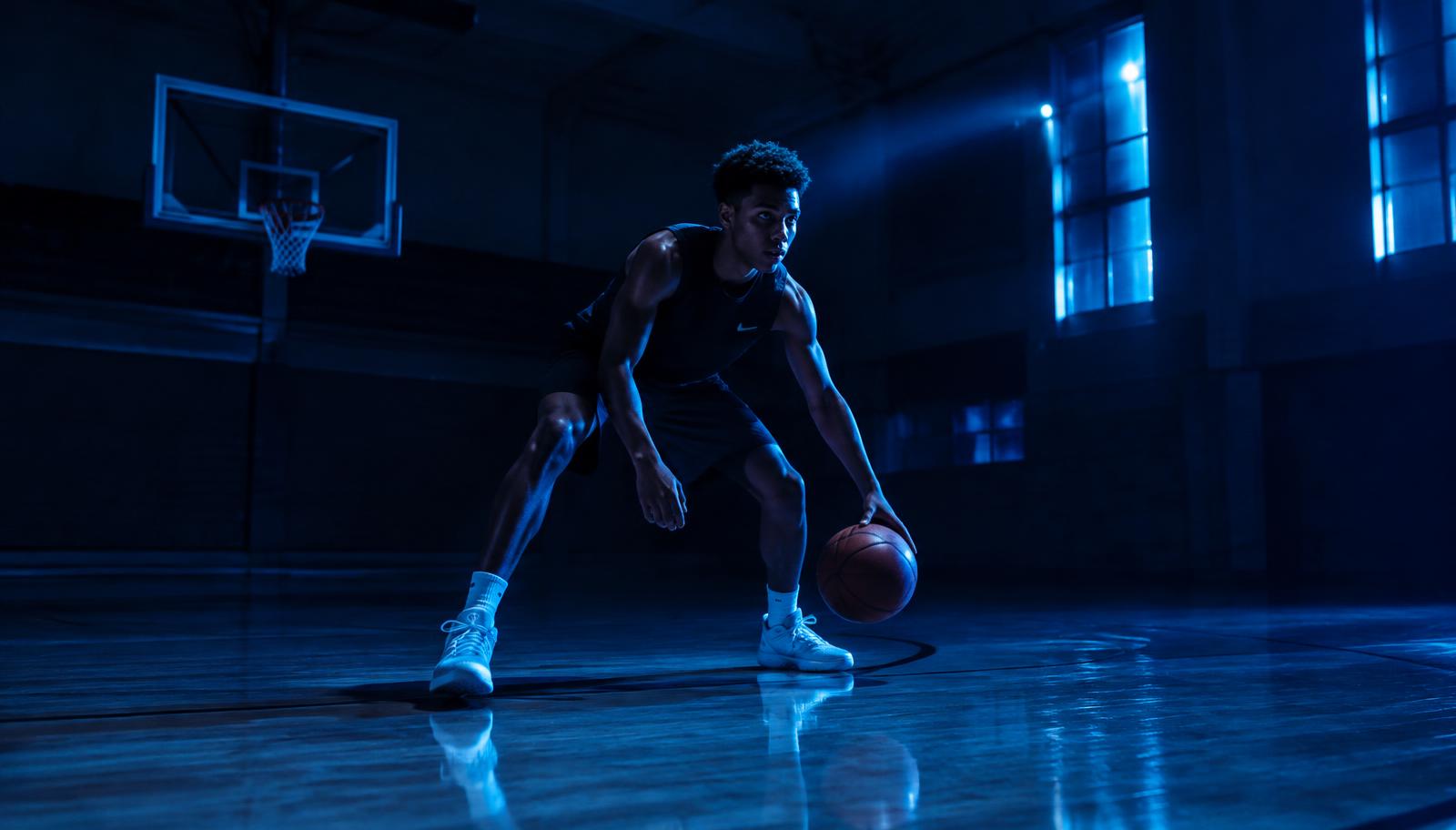
Effective at-home ball handling work needs only a ball and a small flat space: stationary dribbling drills, two-ball dribbling for older kids, and cone or chair dribbling series. Ten to fifteen minutes daily builds real control over a season.
01
Why ball handling is the best at-home investment
Ball handling is one of the few basketball skills that translates almost entirely to a small space. A driveway, garage, or even a hallway is enough to build real handles, unlike shooting or defense which need more room and often a hoop.
Kids who dribble daily in short bursts develop a feel for the ball, tight control at speed, comfort with both hands, that shows up directly in games and gives them confidence to make plays instead of panicking under pressure.
02
A 10 to 15 minute daily series
Younger kids, 7 to 9, should focus on the first three drills done well rather than rushing into two-ball work, which is genuinely difficult and can be frustrating before the basics are solid.
Keep the pace honest. Dribbling slowly with perfect control, then gradually speeding up, builds better handles than dribbling fast and sloppy from the start.
- Stationary pound dribbles, both hands, low and controlled: 1 minute each hand
- Crossovers between the legs, stationary: 2 minutes
- Figure 8 dribble around the legs: 2 minutes
- Two-ball dribbling, both balls same pattern then alternating: 3 minutes (ages 10 and up)
- Cone or chair dribbling series, weaving through with a move at each: 3 to 5 minutes
03
Age-specific notes
Ages 7 to 9: 10 minutes, mostly stationary dribbling and simple cone weaves, framed as a game with a stopwatch. Ages 10 to 12: 12 to 15 minutes, add two-ball dribbling and combo moves, crossover into a hesitation. Ages 13 and up: 15 to 20 minutes, add live-dribble decision drills, dribbling while reading a defender's movement, either a parent or a chair standing in as a defender.
For any age, weak-hand work deserves equal or slightly more time than the dominant hand. Most young players avoid their weak hand naturally, so the home routine is a good place to force that balance.
04
Mistakes to avoid
Do not let your child watch their own hands the entire time. Have them look up, at you, at a spot on the wall, at a mark on the floor, while dribbling. This forces the hands to work by feel, which is what actually happens in a game.
Avoid turning every session into a critique. If your child asks you to watch, give one specific piece of encouragement and one small tip, not a running commentary on every dribble.
05
Turning it into a habit worth rewarding
Ball handling is exactly the kind of daily, controllable work that fits a points system well, because it happens regardless of how any given game goes. In Work Creates the Reward, a family might set a 10 to 15 minute ball handling session as a daily task, approved by a parent, with points building toward something the child picked, new shoes, a trip, extra time with friends.
This keeps the daily grind of dribbling drills connected to a goal your child actually cares about, rather than relying purely on 'because it will help you get better' as motivation.
Try this week
- 1Run the 10 to 15 minute series 4 times this week in the driveway or garage
- 2Add 2 extra minutes of weak-hand-only dribbling each session
- 3Try eyes-up dribbling, looking at you instead of the ball
- 4Time a cone weave series and try to beat it by Friday
Sample weekly point plan
Points for the work your child controls. Wins, stats and roster spots are what that work creates.
Up to 25 pts a week
| Work | When | Points |
|---|---|---|
| Daily ball handling session, 10 to 15 minutesDaily | Daily | 10 pts |
| Weak-hand focused set4x per week | 4x per week | 5 pts |
| Beats personal best on a timed cone seriesAs it happens | As it happens | 5 pts |
| Practices two-ball dribbling3x per week, ages 10+ | 3x per week, ages 10+ | 5 pts |
Parent questions
How long should a young player practice dribbling each day?
10 to 15 minutes daily is enough to see real improvement over a season. Longer sessions rarely add much unless the child specifically wants more.
What age should kids start two-ball dribbling?
Around age 10 is typical, once single-ball stationary and moving dribbles are solid. Introducing it too early can be frustrating and lead to sloppy habits.
Do I need a real basketball hoop for ball handling work?
No. Ball handling drills need only a flat space and a ball. A hoop is only needed for shooting practice.
My child gets frustrated with crossovers, what should I do?
Slow it down. Have them walk through the motion at half speed for a few days before adding speed. Frustration usually means the pace is ahead of the control.
Work Creates the Reward
Turn this plan into a habit your child owns.
Your child logs the reps, prep and recovery they finish. You approve it in seconds. Points build toward rewards your family chooses. See how it works or compare membership plans.
Start Your 14-Day Trial